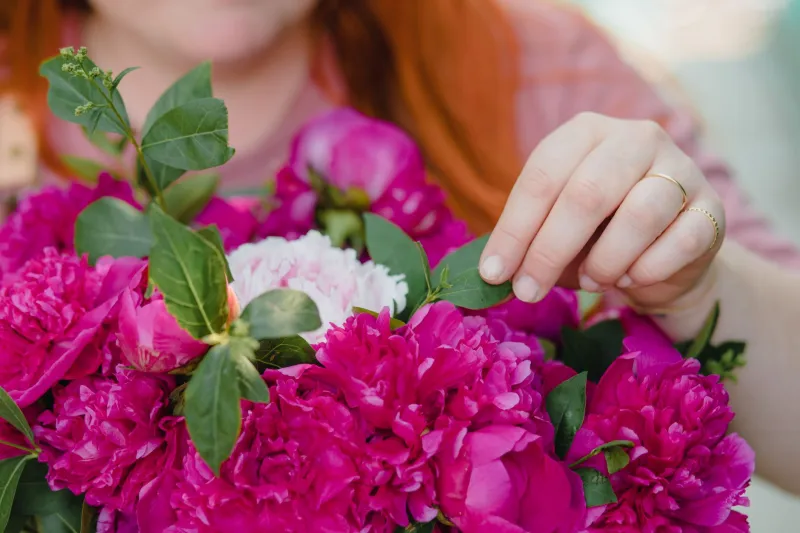
The Last Gather: A November Bouquet That Makes a Fading Garden Look Deliberate

Photo: Jonathan Thacker , CC BY-SA 2.0, via Wikimedia Commons
There is a moment in early November when the garden stops pretending. The dahlias are darker and smaller, the chrysanthemums have opened unevenly, and the seed heads have gone the colour of old paper. The forecast starts using the word frost. That is precisely when a certain kind of bouquet becomes possible — not the tight, hopeful arrangements of high summer, but something quieter, looser and more romantic. A last gather, made by hand, for the kitchen table.
At Tussie Mussie Flowers, we like a bouquet with a bit of history in it. A tussie-mussie was always a small, personal thing — flowers and herbs gathered close, carried for scent or sentiment. This November arrangement is the bigger, more generous cousin: a hand-tied bunch that takes the last of the garden and makes it look as though you meant every faded stem.
Pick with the forecast, not the calendar
The first hard frost is the deadline, but the calendar is not the boss. Watch the weather. If a clear, cold night is forecast, go out the afternoon before and cut what you want to keep. Morning is lovely too, once the dew has lifted but before the sun has had a chance to wilt anything. Take a sharp pair of snips and a clean bucket of cool water with you. The less time stems spend out of water, the better.
Do not wait for the garden to look perfect. It will not. The charm of a November bouquet is that it accepts the season as it is. A slightly battered dahlia, a chrysanthemum with a wonky centre, a branch of berries that has already been pecked at by the birds — these are not flaws. They are the point.
What still earns its place
Start with the last dahlias. By November they are often richer in colour than they were in August — deep burgundy, burnt orange, dusty pink — but the stems can be hollow and sulky. Cut them long, strip every leaf that would sit below the waterline, and get them into deep, cool water straight away. Do not sear the ends. A clean angled cut and a cool bucket will do more for them than any old wives' trick.
Ragged chrysanthemums are next. We mean that affectionately. Garden mums in November have a lovely, unruly quality, and they hold their shape in a bouquet far better than their supermarket cousins. Cut them when the outer petals are fully open but the centre is still tight. Strip the lower leaves — they go slimy quickly — and condition them overnight in shallow water.
Then come the seed heads. Nigella, poppy, honesty, teasel, the flat brown plates of achillea. They give a bouquet its architecture and its sense of time passing. Cut them on a dry day and handle them gently; they shatter if you bundle them too tightly. If a stem is very brittle, a thin piece of wire pushed up the centre can save it, but honestly, a little droop is part of the look.
Berried branches are the romance. Cotoneaster, hawthorn, rosehips, the last of the sloes if you are lucky. Cut them on an angle, remove the lower foliage, and avoid crushing the stems. Berries are heavy, so use them low in the arrangement or let them arch out to one side. They will drop eventually, but that is a small price for that shot of November red.
Finally, scented foliage. Rosemary, bay, myrtle, sage, the last of the mint. These are the stems that make a kitchen-table bouquet smell like something. They also fill the gaps and give the whole thing a soft, garden-gathered shape. Condition them in deep water overnight and they will last for a week or more.
Conditioning the awkward ones
A few stems need a little more patience. Hollow dahlia stems benefit from being cut again under water, then left in a cool, dark place for a few hours. Chrysanthemums like a clean bucket and a sharp cut; do not be tempted to smash the ends, whatever you have read. Woody branches — rosemary, bay, cotoneaster — should have their stems split or cut on a long angle so they can actually drink. Seed heads should be kept out of deep water; a shallow inch is enough. And everything should be conditioned before you start tying, not after.
The formula: three handfuls and a little nerve
We like a simple formula for a generous kitchen-table bunch: three parts structure, two parts colour, one part scent and surprise. Structure is your seed heads, grasses and foliage. Colour is the dahlias and chrysanthemums. Scent and surprise are the herbs, berries and any last sprigs of something scented.
Build it in your hand, spiralling the stems so they sit comfortably. Start with a few structural stems — maybe three seed heads and a branch of berries — and let them cross at the binding point. Add the flowers in small groups rather than one by one; three dahlias together, then two chrysanthemums, then a soft cloud of seed heads. Keep turning the bunch as you go. When it feels almost too loose, tie it tightly at the binding point with twine or a length of silk ribbon, then cut the stems to a length that suits a low vase or a jug.
Making faded look intentional
A faded garden looks intentional when you stop apologising for it. Group colours instead of scattering them. Let the seed heads arch. Leave a few leaves on. Use an odd number of focal flowers. Put the bouquet in a low, wide vessel so the stems can breathe, and let one or two stems fall out to the side. A wide ribbon tied in a soft bow does more for a November bouquet than you might think.
This is not a bouquet that shouts. It is one that sits on the kitchen table and catches the low afternoon light, smelling of rosemary and damp earth. It is the last gather before the frost, and it is all the more romantic for it.