The Bouquet That Knows Your Name: Choosing Wedding Flowers With a Story
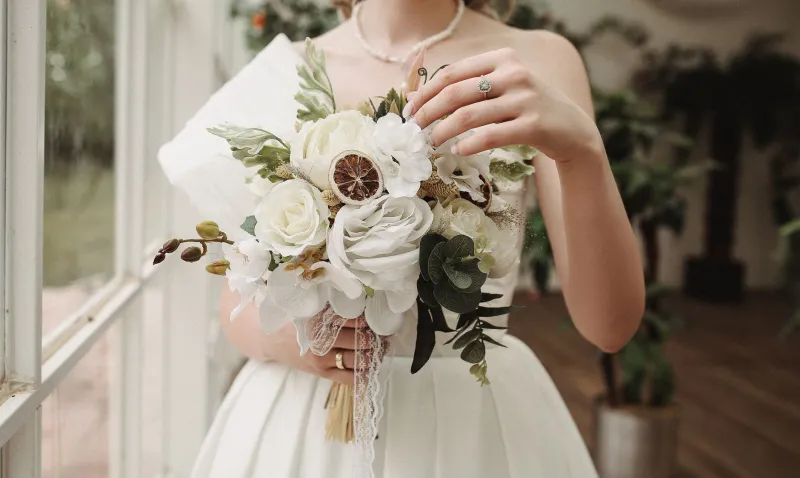
Photo: bride holding romantic British garden wedding bouquet with rosemary and ribbon, via www.molecularit.com
The problem with whatever is trending
Wedding flowers have a way of becoming a performance. There is the mood board, the colour palette, the carefully cropped photographs of bouquets held by people who are not you. None of that is wrong, exactly. Inspiration is useful. But when trends start doing the talking, something gets lost: the bit where the flowers actually feel like the two people getting married.
In 2026, it is easier than ever to copy a look. What is harder, and far more worthwhile, is choosing flowers that carry a bit of your own story. That might mean a sprig of rosemary from a grandparent's garden, a flower that grew outside your childhood kitchen window, or simply a colour that makes you feel like yourself rather than a version of a bride from a magazine.
Every flower has a footnote
Flower meanings are not a new idea. The Victorians made an entire language out of them, and the tussie-mussie posy was a way of saying something without saying it aloud. We still find that romantic. A bouquet can be a small, living footnote to your relationship.
Rosemary is for remembrance. Myrtle is a traditional wedding flower and has been used in royal bouquets for generations. Lavender is calm and homespun. Forget-me-nots do exactly what they say on the tin. Thistles can nod to Scotland, daffodils to Wales, shamrocks to Ireland. A single stem of something meaningful can sit quietly among the more decorative blooms and mean more than the whole arrangement.
You do not need to turn your wedding into a botany lecture. One or two personal touches are enough. The point is not to be clever. The point is to look down at your bouquet and recognise something of your own life in it.
How to brief a florist without writing a mood board essay
A good brief is not a test. It is a conversation. Start with how you want the day to feel, not just how you want it to look. Do you want relaxed and garden-gathered? Polished and architectural? Romantic and a little wild? Are you getting married in a church, a registry office, a marquee or a barn? Will there be candles, low light, a long table, a lot of hugging?
Bring photographs if they help, but bring words too. Tell your florist what you love and what you cannot stand. Be honest about budget early. A florist who listens will not be offended by a number; they will use it to tell you what is possible. Ask what is in season, what can be sourced locally and what might need to be substituted. Ask who will actually make the flowers on the day. These are not awkward questions. They are the foundation of a good working relationship.
Questions that reveal whether a florist listens
There is a difference between a florist who hears you and one who simply waits for their turn to talk. You can usually tell within one conversation. Do they ask about your venue? Do they ask about the people who will be holding the bouquets? Do they notice when you say you hate gypsophila, or when you mention that your mum grows sweet peas?
Ask them what they would do differently if the budget were smaller. Ask how they handle last-minute changes. Ask what happens if a flower is unavailable. A florist who listens will have clear answers and will not make you feel silly for asking. A florist who does not listen will steer every conversation back to their own portfolio.
Red flags are usually simple. They talk over you. They push a package before they know your name. They promise exact copies of photographs without mentioning seasonality. They are vague about costs. They make you feel like you are difficult for wanting blue delphiniums in December. You are not difficult. You are planning a wedding.
The budget conversation is part of the story
Money is not the enemy of romance. It is simply part of the brief. Be clear about what matters most. For some couples, it is the bouquet. For others, it is the table flowers or a show-stopping ceremony arch. Spend where you will actually see and feel the difference.
There are also quiet ways to make flowers go further. Move ceremony arrangements to the reception. Reuse bridesmaid bouquets as table centres. Choose seasonal British foliage to bulk out a smaller number of statement blooms. Use candles, ribbon and a beautiful vase to make a simple arrangement feel intentional. None of this makes your wedding less special. It makes your flowers work harder for you.
Personal details that do not cost the earth
A story-led bouquet does not need a huge budget. It needs thought. A ribbon cut from a mother's wedding dress. A charm pinned inside the stems. A flower grown by a friend. A sprig of rosemary tucked in for someone who could not be there. A pocket square made from the same fabric as the bouquet ribbon.
These details are not decorations. They are the things you will remember when the day goes by in a blur. They are also the things a good florist will help you place without making a fuss.
The story test
Before you book anyone, ask yourself one question: does this feel like us? Not does it look expensive, or on trend, or exactly like the photograph. Does it feel like the two of you? If the answer is yes, you have probably found the right florist. If the answer is no, keep looking. Your flowers should know your name.