Carry It First: The Stand-In Bouquet Every Bride Should Test-Drive

Photo: Unknown authorUnknown author or not provided, Public domain, via Wikimedia Commons
On the morning of a wedding, the bouquet is often the last thing a bride picks up and the first thing everyone photographs. It is also the thing most brides have held only in imagination. A stand-in bouquet — a practice posy, if you like — changes that. It lets you carry something before the day, so the real bouquet is not a surprise in your hands.
At Tussie Mussie Flowers, we build wedding flowers for couples who want a hand-tied, seasonal feel. We also know that a bouquet is not just decoration. It is a prop, a comfort, and something to do with your hands while you say the words. Rehearsing with a stand-in is not about being fussy. It is about removing small unknowns.
Start With Weight, Not Wow
A real bouquet is heavier than it looks in photographs. Wet stems, foliage, ribbon and a generous hand-tied shape all add up. Before you fall in love with a huge, trailing design, make a stand-in that matches the size and stem count you are considering. Carry it for ten minutes. Then carry it for twenty. If your arms ache before you have even left the house, your florist needs to know.
You do not need real wedding flowers for this. A bunch of supermarket stems and a few garden branches can give you a fair idea of weight and balance. If the practice posy feels front-heavy, the real one will too. If it feels too wide under your arm, that is useful information. The aim is not a perfect replica. It is a honest trial run.
The Grip Test: Stems, Ribbon and Real Hands
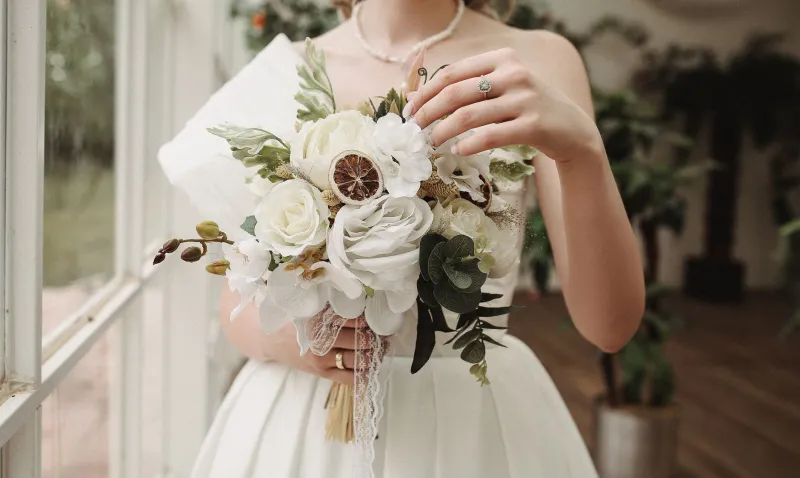
Hold the stand-in exactly as you will hold the real bouquet. One hand at the binding point, the other supporting the stems. Check whether the ribbon slips, whether the stems feel too thick for your grip, and whether the bouquet sits comfortably against your wrist. Some brides prefer a neat, compact tussie-mussie. Others want a loose, garden-gathered hand-tie that spills over the hand. Both are lovely, but they ask different things of your fingers and forearms.
If you are wearing gloves, practise in them. If you have a manicure booked, think about whether you will grip with bare hands or through lace. Small details like this are easier to solve in your kitchen than in the vestry.
Dress Rehearsal: Fabric, Posture and the Aisle Walk
Carry the practice bouquet against your dress, not just in front of a mirror. Lace, tulle, beading and silk all behave differently. A rough stem end or a stray wire can catch. Faux flowers can be scratchy. Wrap the practice stems in tissue or ribbon as your florist will, and walk around the room. Sit down. Stand up. Hug someone. See what happens.
Then put on the shoes. Walk the length of your hallway, or better still, the venue if you can. Practise the pace. Practise the pause at the front. Decide where the bouquet goes when you take your vows — handed to a bridesmaid, laid on a table, or held in the crook of your arm. Rehearse the handover. A bouquet that feels lovely on the arm can feel awkward when you are trying to hold hands and remember your words at the same time.
Angles, Light and the Photograph Test
Ask a friend to take pictures from the back of the room, from the side, and close up. Check whether the bouquet covers the dress detail you paid for, or hides your face when you look down. Test it in the light of the venue if you can, or at least near a window at the same time of day. Some colours go flat in church light. Some whites glow. A stand-in made from supermarket stems will not match your wedding flowers exactly, but it will show you how a shape behaves in photographs.
Look for the angles you love. The bouquet held low. The bouquet resting against your waist. The bouquet lifted as you greet a guest. If the practice posy feels awkward in any of them, mention it. A florist can adjust stem length, width and balance before the real stems are cut.
How to Build a Stand-In Without Wrecking the Real Thing
Keep it simple. Use supermarket stems, garden foliage with permission, or faux flowers. Aim for the same general size and shape as the bouquet you have ordered, not the same exact flowers. Bind the stems with florist tape and finish with a ribbon similar in width to the one you plan to use. Mark the practice posy clearly and keep it away from the real wedding flowers.
Avoid anything that could stain a pale dress: pollen-heavy lilies, berries, dye-heavy petals or dirty stem ends. If your dress is white or ivory, wrap the practice stems well. Do not practise with the real bouquet. It should stay cool, clean and undisturbed until the day. The stand-in is there to take the knocks.
What to Change After the Rehearsal
After your test run, write down three things: too heavy, too long, too wide. Or perhaps: perfect, but the ribbon needs to be softer. Send those notes to your florist. If you can, repeat the rehearsal a week or two later with the adjusted shape. The second carry is always more useful than the first.
The real bouquet should feel like an old friend by the time it reaches your hands. A stand-in bouquet is not about pretending. It is about learning the weight of the day, one stem at a time.